Program Details
PaintCare offers drop-off sites throughout California where the public can take unwanted paint for recycling. These sites are available to households, businesses, government agencies, and others with leftover paint.




Drop Off Paint
Large Volume Pickup (LVP) Service
If you have a large amount of unwanted paint (100+ gallons), PaintCare offers a free service to painting contractors, property managers, and others with large amounts of leftover architectural paint.
Products We Accept
PaintCare sites accept house paint as well as primers, stains, sealers, and clear coatings such as shellac and varnish. Accepted products, also referred to as “PaintCare products” and “architectural coatings,” are the same ones that carry the PaintCare fee when purchased.
Fee and Funding
PaintCare programs are funded by a fee (referred to as the PaintCare fee) which is applied to the purchase price of each container of new paint sold in the state. There is no charge for dropping off paint at a PaintCare drop-off site. The PaintCare fee is not a tax or a deposit. The fee funds all aspects of the paint stewardship program.
For more information on the fee, visit the PaintCare Fee Page.
The fee in California is based on container size as follows:


Official Documents
Summary of 2024 California Annual Report
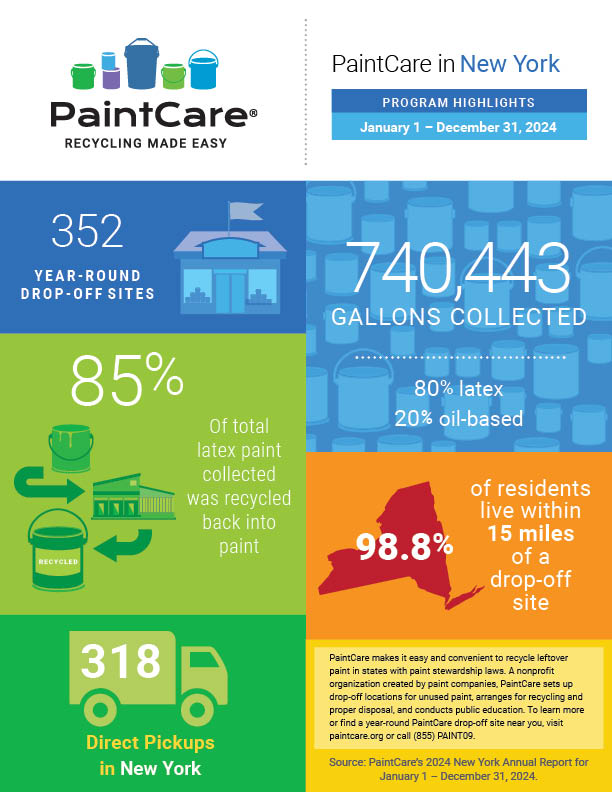
This one-page infographic highlights the successes from the most recent reporting period for the California PaintCare program (January 1 to December 31, 2024). Please consider downloading and printing a copy of the infographic and then posting it for staff and the public at your business or organization.
Annual Reports
Calendar Year
Beginning officially in 2024, annual reports for the California PaintCare program follow the calendar year.
Fiscal Year (July-June)
State Agency
The oversight agency for the California paint stewardship program is the California Department of Resources Recycling and Recovery (CalRecycle) CalRecycle can be contacted by email at
Program Plan
PaintCare’s program plan for California describes the operations, outreach, and other activities of the California Paint Stewardship Program.
- California Paint Stewardship Program Plan (October 31, 2021)
CUPA Inspections
Working with the CUPA Forum Board, CalRecycle, and the Department of Toxic Substances Control, PaintCare has made it easier for California sites to participate in the program through the passage of AB 2748. The law repeals the requirement that paint drop-off locations develop a hazardous materials business plan in order to accept paint from the public intended for recycling.
Law
Laws relevant to the PaintCare program in California can be found at https://leginfo.legislature.ca.gov/
- Public Resources Code (PRC)
- Division 30. Waste Management, Sections 40000 – 49620
- Part 7. Other Provision Sections, 47000 – 48706
- Chapter 5. Architectural Paint Recovery Program, Sections 48700 – 48706
California regulations relevant to the PaintCare program can be found at https://govt.westlaw.com/calregs/
- Title 14. Natural Resources
- Division 7. Department of Resources Recycling and Recovery
- Chapter 11. Product Stewardship
- Article 2. Architectural Paint Recovery Program, Sections 18950 – 18958
Sales Tax
The California Board of Equalization (BOE) has provided an explanation of why the PaintCare Fee is subject to state sales tax in the following letter:
- BOE Letter regarding California Sales Tax (February 13, 2013)